
Key statistics
The Texans behind the policy
Whether you are new to bleeding disorders or have lived with one for thirty years, this is the sourced version — how many Texans, where they are treated, and what treatment costs.
Who lives with this in Texas
Roughly 320,000 Texans, most of them undiagnosed
Bleeding disorders are inherited conditions in which blood does not clot properly, because one of the proteins that makes clotting work is missing or does not function. They are lifelong, and they are treatable.
Estimates, not case counts. Derived from CDC von Willebrand disease data, CDC hemophilia data and 2025 US Census Bureau population estimates.
In your district
What the state figure looks like at district scale
Statewide totals are easy to file away. These are the same numbers divided by the districts they sit in.
| District | Bleeding disorders, all types | Hemophilia |
|---|---|---|
| Texas House 150 districts |
~2,100constituents | ~20constituents |
| Texas Senate 31 districts |
~10,300constituents | ~97constituents |
| US House 38 Texas districts |
~8,400constituents | ~79constituents |
Statewide estimates divided evenly by the number of districts in each chamber. Bleeding disorders do not distribute evenly — districts containing a treatment center will hold more diagnosed patients, and rural districts will hold more undiagnosed ones — so read these as the scale of the population, not a count of a particular district.
The hemophilia figure is deliberately small. Twenty constituents in a Texas House district is a rounding error in most policy conversations — and it is exactly why this community needs someone to speak for it. A condition rare enough to be overlooked, and expensive enough that being overlooked is dangerous.
Derived from the Texas estimates above and the current number of districts in each chamber.
What treatment costs
One vial
$5,000
The card the Coalition hands to legislators says a single vial of clotting factor can cost up to five thousand dollars. A person with severe hemophilia on a preventive schedule uses it two or three times a week, every week, for life.
Factor is not actually priced by the vial. It is priced by the international unit, and a vial holds anywhere from 250 units to 3,000 or more. At roughly $1.20 to $3.00 a unit — the low end for a standard product, the high end for a longer-acting one — a 2,500-unit vial lands somewhere between about $3,000 and $7,500. Five thousand dollars is a fair, conservative version of a more complicated number.
Across a year, clotting factor for an adult with severe hemophilia runs $300,000 to $500,000. For a patient who develops an inhibitor — an immune response that stops ordinary factor from working — the figure can approach or pass $1,000,000.
That arithmetic is why coverage rules, prior authorization and pharmacy networks are not administrative details for this community. They decide whether the medication in that vial is reachable.
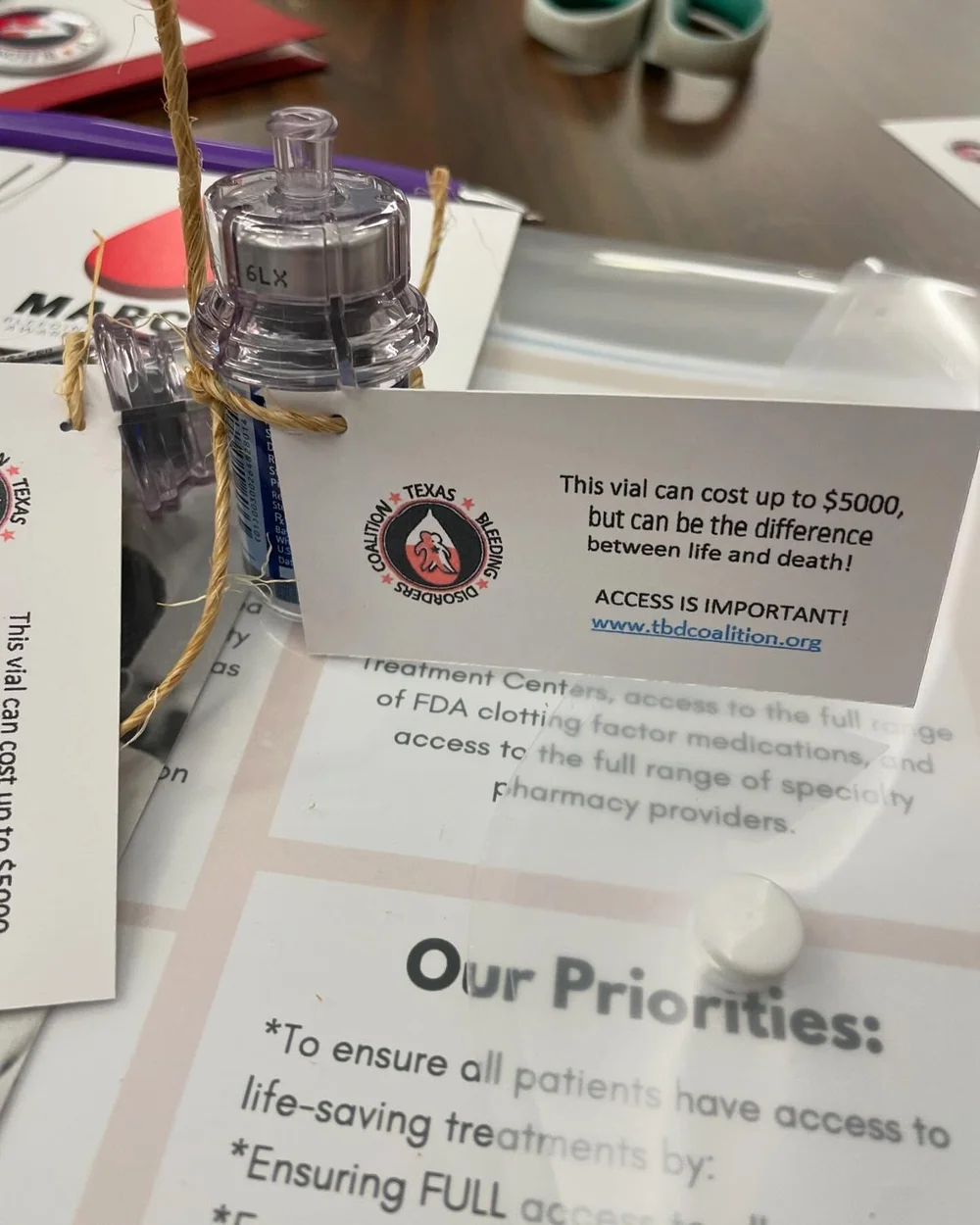
Per-unit prices and the annual range: “The High Price of Hemophilia,” ASH Clinical News, American Society of Hematology — $1.19 a unit for a standard half-life product and $2.85 for an extended half-life one, with some extended products above $4, and $300,000 to $500,000 a year for an adult. The inhibitor figure: The American Journal of Managed Care, which puts mean annual cost with an inhibitor at $697,000 and notes estimates as high as $1 million. These are list-level figures. What any one family is billed depends on the product, the payer and the contract behind it.
Where care happens
Seven treatment centers, in five cities
A Hemophilia Treatment Center, or HTC, is a specialist clinic where hematology, nursing, physical therapy and social work sit under one roof. Care at an HTC is associated with fewer bleeds, fewer hospital visits and longer life. There are 149 HTCs in the United States, and seven of them are in Texas.
Seven centers, five cities — Houston and Dallas carry two each because they run separate adult and pediatric programs. All seven sit in the eastern third of the state.
Care reaches further than those five cities. The centers run outreach and satellite clinics in El Paso, McAllen, Harlingen and Austin, and Gulf States runs mobile clinics at rotating locations. For a family in far West Texas or the Rio Grande Valley, that is the difference between specialist care and none, and the centers deserve credit for building it.
But an outreach clinic is not a comprehensive center. Several are pediatric only, and some meet two to four times a year. A child in the Rio Grande Valley may see a specialist quarterly; the adult that child becomes may be driving to San Antonio. In a state eight hundred miles across, that gap — between where care is complete and where it is occasional — is the access problem this Coalition works on.
Center list from the CDC Division of Blood Disorders HTC Directory, searched September 2026. National count from the National Hemophilia Program Coordinating Center. Texas sits in the Great Plains regional hemophilia network, alongside Arkansas, Iowa, Kansas, Louisiana, Missouri, Nebraska and Oklahoma. Outreach and satellite clinic details from the treatment center listings published by Lone Star Bleeding Disorders Foundation and Texas Central Bleeding Disorders, which are the current lists for South and North Texas respectively.
The national picture
For context
Hemophilia A is three to four times as common as hemophilia B. Sources: CDC hemophilia data; CDC von Willebrand disease data; CDC HTC Directory.
Where to next
Beyond the numbers
We will find the answer, or tell you plainly that we do not have it. We would always rather someone had the facts than a talking point.